
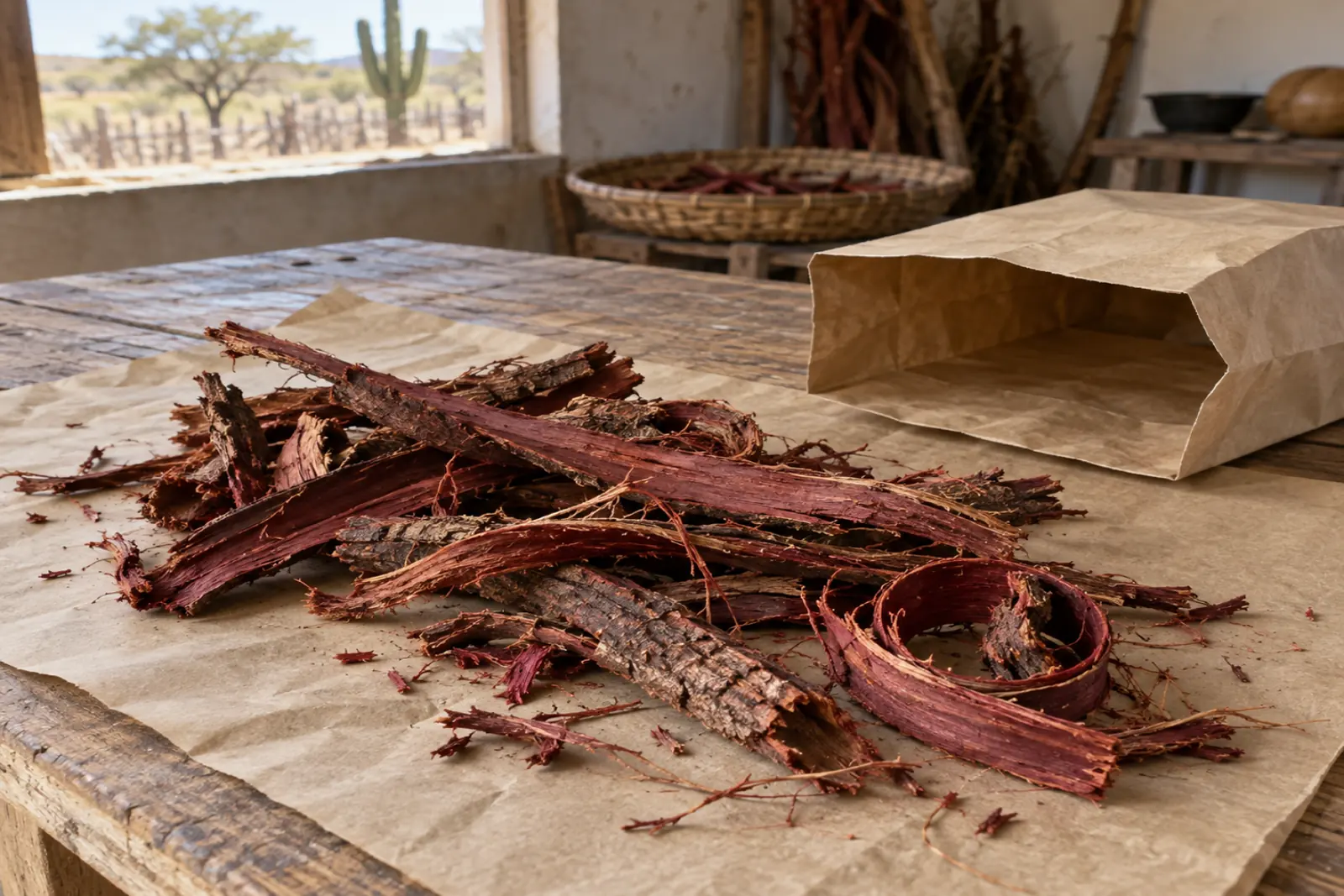
Mimosa hostilis root bark is sold in three forms: whole pieces of inner bark, shredded bark, and powder. They are the same material at different stages of processing, and the difference for a buyer is how much of the bark's condition you can still see. Whole bark lets you judge colour, thickness, dryness and cleanliness by eye; powder lets you judge almost nothing. Avalon Magic Plants sells its bark whole.
What inner bark looks like
The Embrapa monograph describes the bark of the stem as up to 5 mm thick, with a rough, dark brown and lengthwise fissured outer layer and a dark red inner layer (Carvalho 2010). Mexican material is described as reddish brown to greyish, fibrous and astringent, and rich in tannins (Camargo-Ricalde 2000). We found no published description of root bark separately; in the trade, "inner root bark" means the red, fibrous layer under the dark outer skin of the roots.
The red colour comes from tannins, and there are a lot of them. Measurements on stem bark range from 15.5 % condensed tannins by one method to 24.1 % total tannins by another (Calegari et al. 2016), with 23.4 % condensed tannins in bark from a five-year-old stand (Marques et al. 2021). Content changes with the season: trees in fruit and flower held less than trees in green leaf (Azevêdo et al. 2017). Nobody has published the same figures for root bark.
The three forms compared
| Whole inner bark | Shredded | Powder | |
|---|---|---|---|
| What it is | strips and curls as stripped from the root | bark cut or torn into fibres and small pieces | bark milled to a fine meal |
| Judging colour and condition | easy: break a piece and look inside | partly: outer skin and wood are harder to spot | hardly: one colour, no structure |
| Hidden material | visible | can hide sand and bits of root wood | cannot be checked by eye |
| Dust | little | some | a lot; work with a dust mask |
| Surface open to air and damp | smallest | larger | largest |
| Storage | keeps best | good if dry | absorbs moisture fastest |
When researchers process the bark, they mill it and keep the milled particles in hermetically sealed jars, protected from light and air humidity (Calegari et al. 2016). That is a sensible rule for any shredded or powdered bark: the finer it is, the more it needs a closed jar.
Drying is where quality is made
Freshly cut jurema bark is wet. In a study in Paraíba, bark moisture ranged from 47.6 % of dry weight in August, the dry season, to 90.6 % in December (Azevêdo et al. 2014). Bark packed before it is properly dry is bark that will grow mould.
The WHO guidelines on good collection practice describe what good drying looks like (WHO 2003):
- not directly on bare ground;
- in thin layers on racks, turned often, to keep mould from forming;
- out of strong direct sunlight unless there is a reason for it;
- with fire drying kept below 60 °C;
- moisture kept as low as possible afterwards, with ventilated transport that avoids condensation.
There is no official moisture limit for this bark: the European Pharmacopoeia only sets drying limits in monographs, and there is none for Mimosa tenuiflora. A percentage quoted as a "norm" by anyone is their own.
Checking a batch by hand
- Colour inside. Snap a piece. The inner layer should be a deep red to purplish brown. Grey or pale insides point to old or wet material.
- Snap. Dry bark breaks cleanly. Pieces that bend, or feel cool and clammy, still hold water.
- Smell. A musty, cellar-like smell means mould, even when you cannot see it yet.
- Mould. White or green fluff, or a powdery bloom, means the batch was stored damp. Do not keep it next to other plant material.
- Foreign matter. Look for sand, soil, pebbles and pale root wood mixed in. Some outer bark is normal; a lot of it means less inner bark per gram.
Mould on plant material can produce toxins. Pharmacopoeias set limits for aflatoxins in herbal materials at a few micrograms per kilo, which only a laboratory can measure. A visibly mouldy batch is not worth keeping.
Storing bark so it keeps
The shop advises storing its bark cool, dry and dark, away from direct sunlight to keep its colour, and states that whole bark keeps well for years. In practice:
- Split a large bag into glass jars with tight lids, so most of the stock stays closed.
- Label each jar with the scientific name, the date and the batch, as the WHO guidelines ask of every package.
- Keep jars in a dry cupboard, away from heat, sunlight and the kitchen.
- Keep bark out of reach of children and pets, and away from food. The leaves and pods of this tree are known to cause birth defects in grazing goats and sheep (Lima Bezerra et al. 2021).
Why stored bark sometimes darkens over the years is not studied for this species. Tannins in general can darken with air and light; storing the bark dark and closed avoids the question.
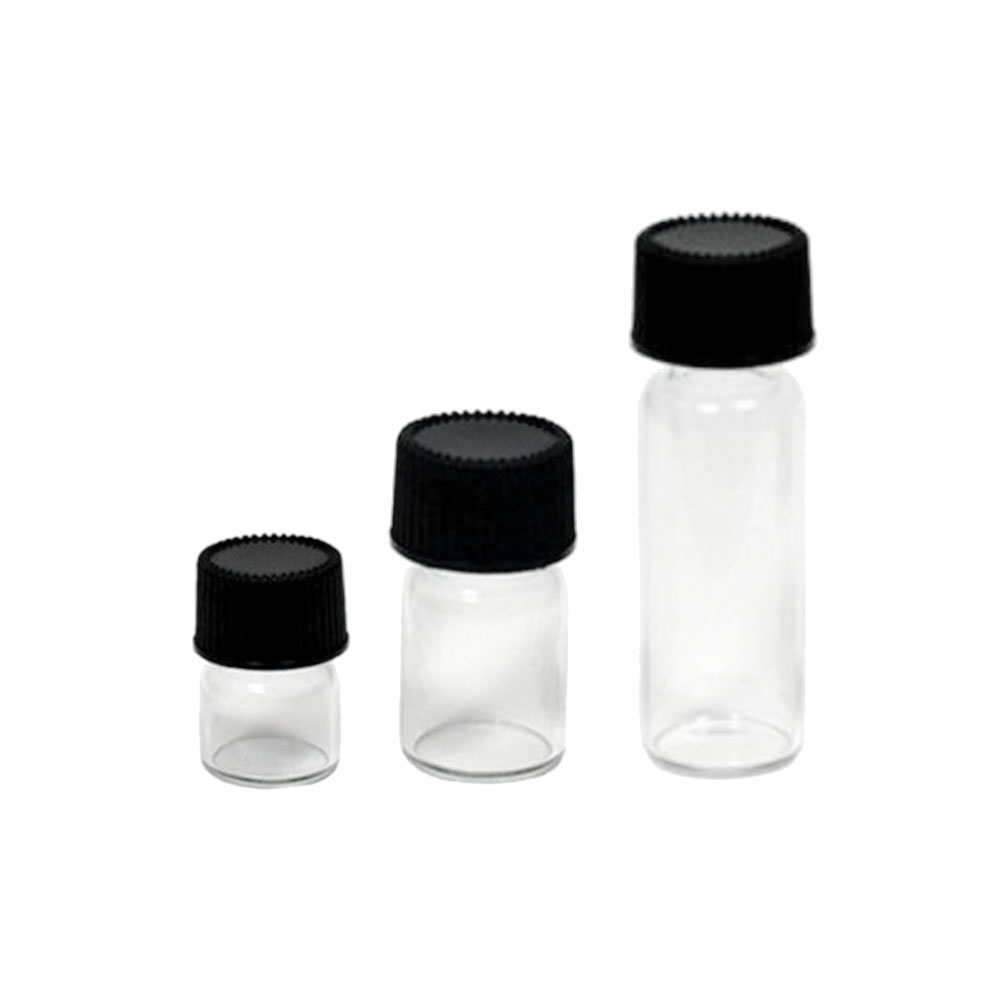 Set of glass jars - S, M and L
View in shop
Contents#1578
Set of glass jars - S, M and L
View in shop
Contents#1578
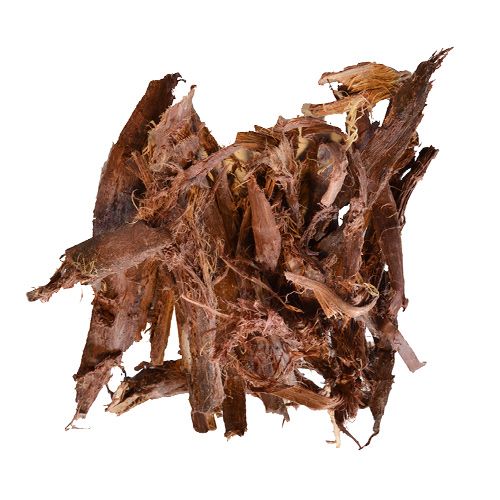 Mimosa hostilis - Inner root bark | Jurema Preta
View in shop
Mimosa hostilis - Inner root bark | Jurema Preta
View in shop
Next on the route: what the label on the bag should say, at the naming checkpoint. Sizes and choices are in the buying guide.