
Root bark can only be taken from roots that have been exposed, and that is about as far as the documentation of the commercial harvest goes. We searched Brazilian forestry research, Embrapa publications and the literature on the tree, and found no technical description of how root bark for export is gathered: who digs, how much of a root system is taken, or what happens to the tree afterwards. This page sets out what is known around that gap.
What a root system looks like
The tree has a deep taproot and a network of shallow side roots, according to the Embrapa monograph on the species (Carvalho 2010). Side roots are the easiest to reach. Cutting through the taproot, or lifting the whole root plate, is a different intervention for the tree.
The only scholarly description of collecting the bark is ethnographic. Souza and colleagues write that most indigenous users "shave the root or stem bark", and that among the Kariri-Xocó the shavings are taken from trees in the forest (Souza et al. 2008). That describes a ritual practice on a small scale, not the export trade.
A yardstick for good collection
For root and bark collection in general, the World Health Organization's guidelines on good agricultural and collection practices are the most specific public standard (WHO 2003). They say that the main roots of trees and bushes should not be cut or dug up, that severing the taproot should be avoided, and that only some lateral roots should be collected. Where bark is the material, a tree should not be girdled or stripped completely. "Only ecologically non-destructive systems of collection should be employed."
These guidelines were written for plant materials in general and are not law in Brazil or Mexico. They are useful as a set of questions to put to a supplier.
How well the tree regrows
Jurema preta is hard to kill by cutting. A study of trees in Pernambuco describes the species as having "good regrowth capacity" and notes that it "regenerates rapidly after cutting or fire" (Mattos et al. 2015). In Caatinga clear-cuts it is usual to leave the base of the stem standing, so that the stump resprouts (Figueirôa et al. 2008).
Regrowth is slow in the wild, though. Mattos and colleagues measured the stems that grew back after a cut in 2003:
| Site | Diameter growth per year |
|---|---|
| Sertânia, Pernambuco (coppiced natural stand) | 0.54 cm |
| Serra Talhada, Pernambuco (coppiced natural stand) | 0.60 cm |
| Limoeiro do Norte, Ceará (plantation) | 1.02 cm |
A plantation reaches stems of 6 to 7 cm at the base in about seven years; coppiced wild trees take around twelve to thirteen years to reach the same size.
All of this evidence concerns stems cut above ground, with the stump and roots left in place. We found no study on how a tree recovers after its roots are dug up or stripped. A tree that regrows from a stump may not survive losing its root bark; nobody has published the answer.
The rules for cutting in the Caatinga
Brazil regulates the commercial cutting of native Caatinga vegetation through sustainable forest management plans. Federal Normative Instruction MMA no. 1 of 25 June 2009 sets a minimum initial cutting cycle of 15 years, and limits a continuous area cut as coppice to 100 hectares (text of IN MMA 1/2009). The rules are written for wood. We found no rule that deals with root bark specifically.
The pressure on the forest
The species itself is not threatened. The IUCN Red List assesses Mimosa tenuiflora as Least Concern, and it is not listed under CITES. As a pioneer, it is recommended for the first phase of restoring degraded land (Carvalho 2010).
The forest around it is under more strain:
- Land cover. The Caatinga lost 9.25 million hectares of natural vegetation between 1985 and 2024, 15 % of what there was, while pasture grew by 11 million hectares (MapBiomas 2025).
- Firewood. In 2024 the north-east produced 11.8 million cubic metres of firewood from wild vegetation, 57 % of Brazil's total, according to the national extraction survey (IBGE, table 289). Jurema preta is one of the trees cut for it: Embrapa describes its charcoal as high in heat value and used in forges.
- Desertification. Around 181,000 km² of the semi-arid north-east is affected by desertification, with four core areas in Seridó, Irauçuba, Gilbués and Cabrobó (Accioly 2010, Embrapa).
Against that background, root bark for export is a small and undocumented use of a common tree. The open question is the one any buyer can ask: was the bark taken from side roots of living trees, or from trees that were cleared anyway, or from whole root systems.
Questions worth asking a seller
- Which region was the batch harvested in, and in which month?
- Was the bark taken from wild trees or from managed or cleared land?
- Is it inner bark only, and how was it dried?
Avalon Magic Plants says it imports its bark directly from Brazil and receives new shipments monthly. Its customer service is the place for questions about a specific batch.
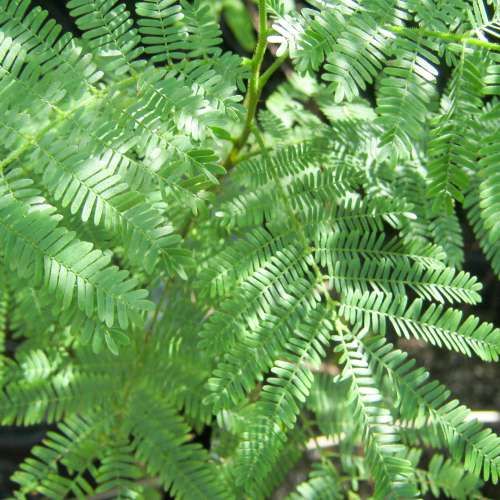 Mimosa Hostilis (Jurema Preta) 10 Seeds
View in shop
Contents#5953
Mimosa Hostilis (Jurema Preta) 10 Seeds
View in shop
Contents#5953
 Avalon Heating Mat Small - 14x15 cm
View in shop
Avalon Heating Mat Small - 14x15 cm
View in shop
A home-grown tree is no bark source: it would take years in a heated pot before its roots were worth anything, and digging them would end the plant. Grow it for itself. Next on the route: drying and sorting, at the forms and quality checkpoint.